
THE GANDHISERVE ARCHIVE
About Peter Ruehe
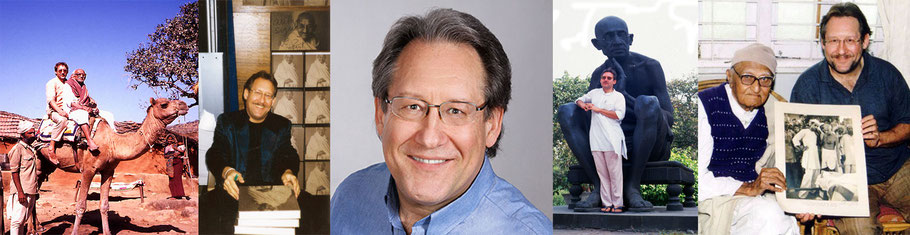
Peter Ruehe is a computer engineer who worked in his profession for over 23 years. He was also a member of the German peace movement in the early 1980s when his interest in the life and work of Mahatma Gandhi began. Together with an Indian friend, Peter Ruehe visited India for the first time in 1983 – and fell in love with its people, culture and history. Out of personal interest he studied Yoga, Ayurveda and the Indian independence movement thoroughly.
In total Peter Ruehe spent about 8 years in India where he visited Gandhian projects, associates and relatives of the Mahatma systematically. By this he got a rare insight into the inner circle of the Mahatma and was able to develop a profound understanding of Gandhi and the context he lived in. Peter Ruehe documented activities of institutions and recorded talks with eye witnesses. He was also able to safeguard precious material on and by Gandhi. Specifically he’s responsible for the preservation and accessibility of several photo collections and films of the Mahatma.
In Germany he shared his experiences with his countrymen and initiated the charitable Gandhi Information Centre in 1983. Later on he founded GandhiServe, a network of institutions in Germany and India promoting Gandhi’s life and the ethics of nonviolence. As a consultant Peter Ruehe was involved in numerous media and performing art productions on Gandhi. He compiled various exhibitions on Gandhi which were shown the world over.
How did this archive come about?
By Peter Ruehe
In over 35-years of systematic search-n-research for yet unknown material on and by Mahatma Gandhi I visited numerous associates, contemporaries, photographers, collectors and relatives of Gandhi, all over India, and also abroad. I recorded first-hand information about Gandhi and India's independence movement, and helped safeguarding treasured films, letters, photographs, negatives, documents and artefacts.
The collection was assembled by me from the mid-1980s onwards, when I began to travel India widely in the footsteps of Mahatma Gandhi. Part of the material has been presented to me as remuneration for my services and others I bought.
The most comprehensive photo collection of over 9,000 photographs of Mahatma Gandhi and India’s independence movement was owned by the late Vithalbhai K. Jhaveri (1916-1985), a Mumbai-based biographer of Gandhi. Jhaveri was a member of the Indian National Movement and did much to promote Gandhian philosophy and preserve the memory of the unique nonviolent struggle for Indian independence. He made it his life's mission to collect photographs, films and footage of the Mahatma - his life, time and work, from sources around the world. Jhaveri became one of Gandhi's most eminent biographers. His material on Gandhi, Jhaveri used exclusively for his own exhibitions, films and publications, but the majority of images were never exposed to the public, i.e. they were never made available for research, publication or personal use. After Jhaveri's death, I visited his estate in Mumbai and found the photographs stuffed in a huge wooden overseas trunk on a terrace next to the seashore. Due to the high humidity in Mumbai, some photographs were already damaged beyond repair. Jhaveri's family agreed to give the - just - surviving photographs a preservation treatment and to catalogue them scientifically. As none of the Indian institutions approached were prepared to do the needful, the photographs were sent to me to Germany, where I did the necessary work within five years. They got cleaned, put in chronological order, captions were worked out carefully, repro negatives were prepared, and prints, and the whole collection got stored in an archival environment using parchment bags and acid-free paper as well as plastic covers without softener. As token remuneration I was permitted to select about 1,000 surplus photo prints.
A similar fate had Kanu Gandhi's collection, which is the second largest photo collection on Mahatma Gandhi after Jhaveri’s, but the largest collection of a single photographer. Kanu Gandhi (1917-1986), Gandhi's great nephew, lived with his family in Gandhi's ashrams in Ahmedabad and in central India, near Wardha. Kanu was a member of Gandhi's personal staff and they worked closely together until his assassination on January 30, 1948. In 1936, he was given his first camera and a roll of film and thus began his documentation of the last ten years of Gandhi's life. Gandhi allowed Kanu to photograph him on three conditions: Kanu was not to use flash, the ashram would not finance it, and Gandhi would never pose. Kanu Gandhi was the only one allowed to take his granduncle's photographs at any time. He was thus able to capture Mahatma Gandhi in all his moods and moments. His photographs are of rare intimacy, presenting Gandhi in the company of his family and other ashram members; it is the private Gandhi in contrast to the public Mahatma. In 1985, I met Kanu Gandhi at his home in Rajkot (Gujarat).
Proudly, he showed me his precious photographs. After Kanu Gandhi's death in the following year, I paid a condolence visit to his widow Abha, who was known as one of the two 'living walking sticks' Gandhi used to lean on during the last years of his life, and in whose arms Gandhi died. During Kanu Gandhi's life, nobody was allowed to enter his photo lab. Now, after his death, it needed to be cleared. When asked what she was going to do with the thousands of – mainly Gandhi’s - photographs flooding the shelves, cupboards and even the floor, Abha said that she would discard them, because she lived with Gandhi and therefore does not need photographs in order to remember those precious days with Bapu (father). Moreover, she owns an album of her late husbands main photo collection. I convinced her not to throw the prints and negatives away as for others they would be invaluable in order to get a realistic picture of the Mahatma. Partly Abha Gandhi sold me her surplus photographs, films and some negatives but a lot of material she gifted to me when I assisted her to work out the captions of her late husbands collection in the years following his death.
GandhiServe's films and photographs are the images of history rescued from the oblivion of mortality. Long after those who died to take these pictures are gone, long after those of us who knew them and survived them and remember their experience are gone in our turn, the images they captured will remain to show generations to come the face of India's struggle for independence.